
The integration process and immigration policy in Spain have fundamentally changed. The entry into force of the latest legislative reform—the updated version of the Reglamento de Extranjería—has ended the era of an exhausting, mandatory three-year wait for immigrants. Today, to emerge from the legal vacuum and obtain official residency, the state has reduced the mandatory residence period to 2 years for those entering the labor market.
This is one of the most humane and pragmatic steps in Spain's immigration history, aimed at revitalizing the labor market and eliminating illegal employment. In this article, we will analyze in detail the updated legal framework and the strategic steps that ensure the secure acquisition of papers under the two-year model.
The New Reform Framework and the Two-Year Rule
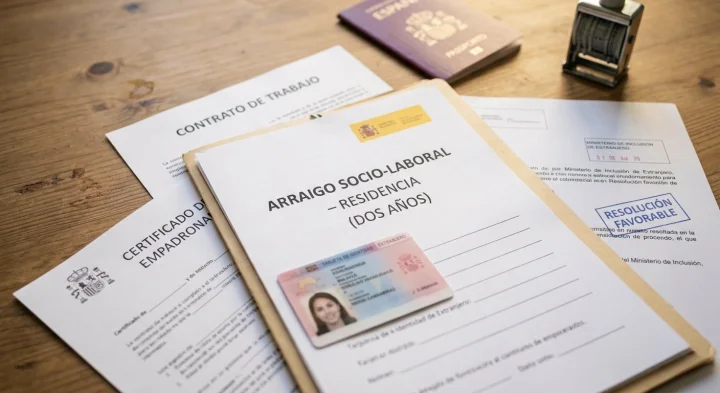
With the latest amendments to immigration regulations, the Spanish government has optimized the categories of Arraigo (establishing ties/taking root). The main novelty concerns the drastic reduction of the time threshold: a non-EU citizen who is in Spain with an irregular status can now apply for a temporary residence and work permit based on the so-called Arraigo Sociolaboral after 24 months of continuous living.
To gain this right, satisfying exact administrative criteria is essential. As the time period has decreased, the scrutiny of document authenticity by the relevant authorities (Extranjería) has become much stricter.
The secret to a successful application begins on the very first day of your arrival in Spain. The new law reduces the wait time, but it does not forgive bureaucratic mistakes.
The primary prerequisite is a continuous presence in the country over the last 2 years. The term "continuous" legally means that during this period, your total time spent outside of Spain must not exceed 90 days. The undeniable proof of this fact is the historical certificate of municipal registration (Certificado histórico de empadronamiento).
In terms of labor guarantees, the system has become more flexible, though the financial clean record of the employer remains crucial. You must present a preliminary employment contract (Contrato de trabajo) that meets the following conditions:
Working time must be at least 30 hours per week.
The salary must not be less than the Minimum Interprofessional Wage (SMI — Salario Mínimo Interprofesional), proportional to the working hours.
If the applicant has a minor child or a dependent requiring care, the law allows the submission of a 20-hour contract.
Social Integration Report
In certain cases, if you do not have a first-degree relative who is an EU citizen, obtaining a Social Integration Report (Informe de Inserción Social) is required. During the interview at the City Hall, your language proficiency, community ties, and living conditions will be assessed.
To make it easier for the reader to grasp, let's review the main differences brought about by the new law:
Reduction of the mandatory waiting period: The old rule required 3 years (36 months), whereas the new regulation strictly defines this period as 2 years (24 months).
Limit on leaving the country: Previously, it was permissible to leave for a maximum of 120 days, but under the new regulation, the total time spent outside Spain over the 2-year period must not exceed 90 days.
Flexibility of the employment contract: The standard 30-hour weekly schedule is maintained (or 20 hours for cases involving dependent care), although the volume of bureaucratic documentation to be submitted by the employer has been significantly simplified.
State focus: The emphasis has shifted from dry social ties to a practical synthesis of labor and social integration, which reduces the probability of rejection.
Procedural Steps and Administrative Costs
Document preparation requires absolute legal precision. Foreign documents (for example, a police clearance certificate from your home country) must be apostilled and translated by a certified sworn translator in Spain (Traductor Jurado).
The state fee is standard—you must pay Tasa 052 (Epigraph 2.5), which costs approximately €38.28. The application is submitted at the Immigration Office (in person, by appointment) or, which is much faster and more efficient, through the electronic platform (Mercurio) with the help of an immigration lawyer.
Tips for Avoiding Complications
Since the timeframe has been reduced to 2 years, every single month is of crucial importance. If you are currently in an irregular status and only have a passport, be sure to consider the following recommendations:
Continuity of the Padrón is critical: When changing your residence, do not allow any gaps between registrations. Even a two-week loss of the empadronamiento could reset your 24-month countdown to zero.
Pre-screening the employer: The Immigration Office is ruthless if the company or individual offering you the contract has even a minor debt with the Tax Agency (Hacienda) or Social Security (Seguridad Social). Before submitting documents, request their certificates of debt clearance (Certificado de estar al corriente).
Leaving an official trail: Mere registration is often not enough. Consistently accumulate a history of visits to the medical center (Centro de Salud), acquire a local library card, and collect language course certificates so that your integration is beyond doubt.
After successfully overcoming this 2-year hurdle, you will receive the highly desired resident card (TIE - Tarjeta de Identidad de Extranjero), granting you the right to live and work legally throughout the entire territory of Spain.
This article is prepared based on the official legislative sources of the Kingdom of Spain and verified data from the Official State Gazette (BOE).
— Discover your Spain


